lunedì 12 novembre 2012
What are the arguments of civil society against ACTA?
-ACTA has the potential to severely limit the free flow of information on the web and the free exchange of ideas between people around the world.
-ACTA is useless against counterfeiting. In fact, China, Russia, India and Brazil, the largest producers of counterfeit goods in the world, did not adhere to it and have publicly stated that they never will do it.
-According to the proponents of the agreement, ACTA should protect public health by preventing the spread of fake and dangerous drugs. But these are not crimes and violations of individual property like ACTA claims. According to various organizations, ACTA will therefore have negative effects on access to medicines, especially in the south states.
The protests were numerous throughout the world. Among most important in Europe should enumerate those that occurred in Poland: more than a thousand people protested outside Parliament in Warsaw January 24, 2012; January 25, 15 thousand people protested in Krakow, 5000 in Bratislava. Even in Sweden there has been much disagreement, as well as in Germany.
A real protest was to Kader Arif, the European Parliament ACTA supervisor who resigned from his post denouncing the lack of transparency in the negotiations.
by Micaela Cancian

DO YOU KNOW WHAT IS ACTA?

Acta is the acronim of Anti-Counterfeiting Trade Agreement. It is a multinational treaty. The agreement aims to establish an international legal framework for targeting counterfeit goods, generic drugs and copyright infringement on the Internet, would create a new govering body such as the WTO (World Trade Organization),or the World Intellectual Property Organization.
In October 2011 ACTA was signed by Canada, Marocco, Japan, Australia, New Zeland, the United States, South Corea and Singapore. As well, in Jenuary 2012, the European Union and 22 member states of 27 countries in EU, signed Acta.
The supporters of Acta, during the months, have described the agreement as an answer to the increase in global trade of counterfeit goods and pirated copyright protected works". A lot of intellectual property- based organization like Manufacturers of America and Pharmaceutical Research were active in the treaty's development. The opponents of the agreement sad and nowaday say that an agreement like ACTA is against the fundamental rights, including freedom of expression and privacy. The secret nature of negotiations has excluded civic society groups and the general public from agreement's negotiation process. EFF (Electronic Frontier Foundation) and Entertainment Consumers Association affirmed that Acta is a "policy laundering".
lunedì 5 novembre 2012
Debunking the EU Commission's Lies About ACTA
Paris, January 30th, 2012 – The EU Commission is engaging in an all-out offensive to portray ACTA as normal trade agreement harmless to fundamental rights or access to knowledge. In several published documents, the Commission's attempts to impose ACTA onto the EU Parliament while silencing legitimate criticism. But these misrepresentations don't resist scrutiny.
As EU executive branch (EU Commission plus 22 Member States governments) officially signed ACTA1, the way is now open for its consideration by the European Parliament. Its 754 elected members now have an opportunity, during a process that will last for several months, to either accept or reject ACTA.
 Members of the European Parliament (MEPs) are already under great pressure, not only from the copyright industry lobbyists, but also from the European Commission's “International Trade” directorate2, who negotiated the text in total opacity during 3 years. Citizens must contact the Members of the EU Parliament (MEPs) to denounce the Commission's infuriating lies, and urge them to ensure that the EU's democratic values will be preserved. MEPs must commit to working in their respective committees towards the rejection of ACTA.
“The EU Commission is plainly lying to the Members of the European Parliament by presenting ACTA as an acceptable agreement. By signing ACTA together with EU Member States, the EU Commission dismissed the legitimate concerns of thousands of citizens across Europe who have been protesting against ACTA in the past few days. Citizens must contact their elected representatives and remind them what ACTA is all about: circumventing democracy and hurting freedoms to protect the outdated business models of rent-seeking industries.”, said Jérémie Zimmermann, spokesperson for La Quadrature du Net.
Download our analysis (in PDF) debunking the EU Commission's lies on ACTA.
ACTA is worse than SOPA
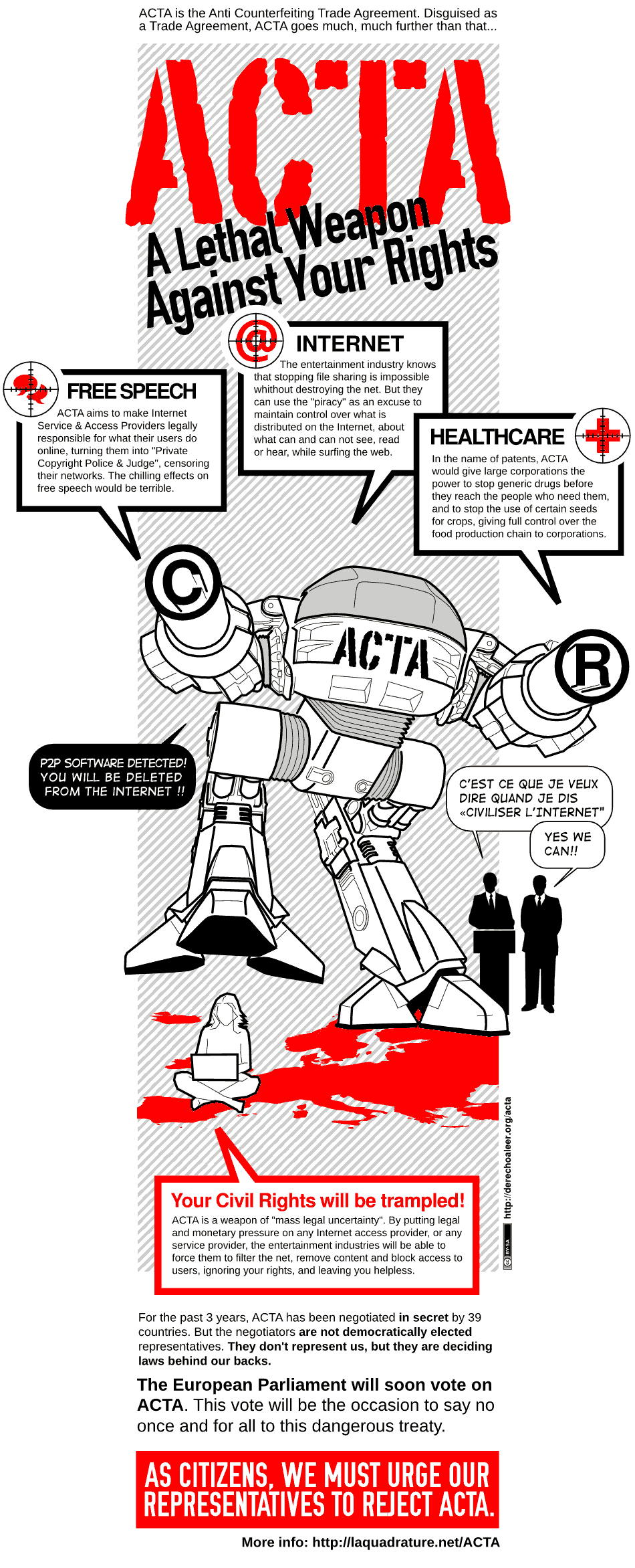 On its website, the EU Commission pretends that ACTA “is not SOPA”. This is correct. In some important ways, ACTA is worse than SOPA. ACTA is the global blueprint for repressive laws such as SOPA:
- ACTA is the inspiration for SOPA/PIPA in the US. While SOPA may have been put aside for a moment, ACTA is a global agreement negotiated outside of democratic arenas and meant to be imposed globally. Moreover, if SOPA were to be adopted, the US Congress could amend or abrogate it. ACTA will prevent the EU and its Member States as well as other signatories to change their copyright and patent laws, and to fix their broken and brutal enforcement policies to adapt to the new economy of sharing.
- If ACTA is adopted, it will be possible for the entertainment industry to exert pressure on every Internet actor under threat of criminal sanctions (art.23). Intermediaries will thus be forced to deploy (art.27) automated blocking, filtering of communications and deletion of content online. Such measures will inevitably restrict users' freedoms online.
- ACTA's call for “cooperation” between rights-holders and Internet service providers is also advocated by the European Commission as “extra-judicial measures” and “alternative to courts”. This means that police (surveillance and collection of evidence) and justice missions (penalties) could be handed out to private actors, bypassing judicial authority and the right to a fair trial. By defending this SOPA-style policy in ACTA, the Commission is paving the way for the copyright industries' enforcement agenda, preventing any true debate on alternative to repression. This fits with the announced revision of the IPRED and eCommerce directives.
See also La Quadrature's analysis of the final text of ACTA's digital chapter.
Debunking the EU Commission's "fact-sheet" on ACTA
In a document published on its website and circulating in the EU Parliament, the Commission conveys more lies about ACTA.
1. “ACTA is important for the EU's external competitiveness, growth and jobs as well as to the safety of citizens”
- ACTA is a direct by-product of the lobbying offensive launched in 2004 by the International Chamber of Commerce, presided by the then CEO of Vivendi-Universal Jean-René Fourtou, whose wife acted as EU Parliament rapporteur for the IPR Enforcement Directive (IPRED) adopted the same year. It is one of the worst examples of private interests taking over policy-making.
- ACTA may have been negotiated like other trade agreements, but it is not just a trade agreement on tariffs. Instead, ACTA generalizes extreme civil sanctions and broadens the scope of criminal sanctions.
- Binding the EU to such outdated models, and deploying schemes that can be used as anti-competitive weapons will only hamper innovation, competition and growth. Not only in the digital economy, but in many fields which rely on the free sharing of knowledge, from agriculture to healthcare.
- There was never any impact assessment on the need for such an plurilateral agreement. The Commission never proved that tougher enforcement standards worldwide would actually benefit the EU's public interest, much less the rest of the world's.
- Instead of imposing ACTA to developing countries, the EU should urgently look at the broader consequences of its current policies (EUCD, IPRED) on innovation, access to culture and fundamental rights, and reform these policies to lay the foundation of a true knowledge-based economy.
- Contrary to the Commission's claims, transparency on ACTA was only made possible after negotiation documents were leaked by insiders worried of ACTA's consequences. These leaks forced the negotiators to release negotiation texts in the Spring of 2010, more than 3 years after the beginning of the negotiations.
- The negotiation and implementation of ACTA bypasses legitimate international organizations (WTO, WIPO) where copyright, patent and trademarks policy are discussed. This is all the more unacceptable considering that a growing number of countries understand the importance of reforming these policies by breaking away from blind repression.
2. “ACTA is a balanced agreement, providing adequate protection to sectors in need, while safeguarding the rights of citizens and consumers”
- Safeguards in the text are purely generic and declarative, mostly in the general parts of the agreement, where enforcement provisions, generally vaguely worded, are binding to signatories. For instance, a study by legal professors Kroff and Brown stresses that ACTA “overall significantly strengthens enforcement measures (especially criminal law ones), without any of the safeguards and exceptions needed to ensure a balance of interests between right holders and parties”.
- The Commission says ACTA does not go further than the EU acquis, but leading EU legal scholars have made clear that on important points it does: in particular on criminal measures, for which there is no EU acquis, and on border measures and damages.
- The letter of ACTA may not be contrary to the eCommerce directive, EUCD or IPRED, but strengthens them and prevents EU lawmakers from amending them on crucial points.
- The overall logic of ACTA's digital chapter paves the way for extra-judicial measures, similar to those of SOPA and PIPA, whereby rights holders and ISPs or financial service providers would “cooperate” to take “measures” against alleged infringements that could only amount to censorship mechanisms, bypassing due process and the right to a fair trial.
- This reading is comforted by the criminal sanctions provided for “aiding and abetting” infringements (art. 23.4). Such concerns are also accentuated by the EU Commission's IPR strategy and the current overhaul of the IPRED and eCommerce directive.
3. “ACTA is about adequately enforcing existing intellectual property rights, but does not create new rights”
- ACTA modifies the scope of criminal sanctions in EU Member States, ensuring they will be applied for cases of infringement on a “commercial scale”, defined as “direct or indirect economic or commercial advantage” (art. 23.1). This term is vague, open to interpretation, and just plainly wrong when it comes to determining the scope of proportionate enforcement, as it does not make any distinction between commercial and non-profit infringement. Widespread social practices, like not-for-profit file-sharing between individuals, as well as editing a successful information website or distributing innovative technological tools, could be interpreted as “commercial scale”.
- By extending the scope of criminal sanctions for “aiding and abetting” to such “infringement on a commercial scale”, ACTA will create legal tools threatening any actor of the Internet. Access, service or hosting providers will therefore suffer from massive legal uncertainty, making them vulnerable to litigation by the entertainment industries.
- The Presidency of the Council of the EU (representing the 27 Member States governments) had to negotiate ACTA in conjunction with the Commission. The Presidency negotiated the “criminal sanction” chapter of ACTA, which could not be negotiated by the Commission as criminal law is part of Member States' competencies. This illustrates that there is no EU acquis on criminal sanctions and proves that ACTA does change EU law.
- Beyond broadening the scope of copyright, patent and trademarks enforcement, ACTA establishes new procedural rules favouring the entertainment industries. These procedures will have a dramatic chilling effect on potential innovators and creators, especially considering ACTA's insane damage provisions (during a trial, right holders will be able to submit their preferred form of damage computation, see art. 9.1).
- In the future, ACTA's scope could also be easily expanded through the “ACTA committee”. The latter will have authority to interpret and modify the agreement after it has been ratified, and propose amendments. Such a parallel legislative process, which amounts to signing a blank check to the ACTA negotiators, would create a precedent to durably bypassing parliaments in crucial policy-making, and is unacceptable in a democracy. This alone should justify that ACTA be rejected.
4. “ACTA has a broad coverage, so as to protect all European creators and innovators, through a broad range of means”
- China, Russia, India and Brazil, countries where most of counterfeiting is produced, are not part of ACTA, and have stated publicly that they will never be. Considering the widespread opposition to ACTA, the agreement has lost all legitimacy on the international stage.
- Again, the Commission has not even proved the need for new enforcement measures nor that existing TRIPS measures are not enough.
- The Commission keeps stepping up repression, when in many instances counterfeiting is at its core a market failure due to the inadequacy of IPR holders' business models and contracts. At the same time, no EU Commission initiative exists to take a positive approach on discussing new financing models for the culture economy fit for the digital environment.
- Geographical indications – a key point for Europe's small businesses and cultural heritage – are mostly excluded from ACTA. The few references to geographical indications in ACTA will have no or very little effect on third countries' national law.
Get in touch with Members of the EU parliament and make sure they know what ACTA is really about. Visit our our dedicated campaign page.
FFII has also drafted a detailed response to another EU Commission document on ACTA called “10 myths about ACTA”.
- 1.http://www.laquadrature.net/en/acta-signed-by-the-eu-lets-defeat-it-together
- 2.DG Trade and its commissioner Karel De Gucht are responsible for ACTA within the EU Commission.
- 3.http://www.laquadrature.net/files/Debunking_the_EU_Commissions_fact-sheet_on_ACTA.pdf
MSF Briefing document updated February 2012 http://www.msfaccess.org
A BLANK CHEQUE FOR ABUSE
The Anti-Counterfeiting Trade Agreement (ACTA)
and its Impact on Access to Medicines
Eight countries - Australia, Canada, Japan, Morocco, New Zealand, Singapore, South
Korea and the United States – signed ACTA on 1st October 2011. The European Union
and 22 of its Member States signed on 26th January 2012. Five EU Member States-
Cyprus, Estonia, Germany, Netherlands and Slovakia - have not yet signed the
agreement. For the agreement to become legally binding on a party it must first be signed
and then ratified by that party. Within the EU, the agreement must be separately ratified
by the European Parliament, individual Member States and the EU Council- this has not
yet happened.1
As a treatment provider, Médecins Sans Frontières (MSF) is deeply concerned about the
impact of the enforcement agenda on the production and supply of affordable, legitimate
medicines. We urge contracting States not to sign or ratify ACTA unless all concerns
related to access to medicines are fully addressed.
The context
MSF relies primarily on generic medicines procured internationally. So too do the
major procurers of AIDS medicines worldwide - the Global Fund and PEPFAR.2Many
developing countries have no domestic pharmaceutical manufacturing capacity and
governments and patients rely on imported generic medicines. Generic competition is the
main driver of pharmaceutical price reductions.
-o-
It is a public health necessity that the trade in affordable and legitimate
medicines functions smoothly and without undue burdens. If a patient misses a
lifesaving drug, even due to temporary delays, there can be potentially life-threatening
health repercussions.
-o-
MSF has been increasingly concerned by the proliferation of enforcement
measures that harm access to medicines and which have been pushed in a number of
different forms– as a part of free trade agreements, international treaties, domestic
legislation and customs regulations.
MSF Briefing document updated February 2012
2
ACTA is a part of this trend, and is the result of the intellectual property enforcement
agenda advanced by rich countries, outside of multilateral norm-setting institutions.3 The
enforcement agenda blurs crucial distinctions between types of IP rights and provides
excessive punishment, increasing the likelihood that wrongful searches, seizures and
legal actions against legitimate suppliers of generic medicines will be carried out. As well
it widens the scope of actors that could have penalties brought against them, so that the
whole medicines supply chain becomes affected.
-o-
Overbroad enforcement measures can threaten access to medicines. The impact of
this has already been documented, for example in relation to the 2008 Anti-Counterfeit
Act in Kenya4 which is currently being by challenged people living with HIV.
-o-
International trade rules are clear on a countries’ right to protect public health
and in particular promote access to medicines for all. The TRIPS Agreement is the
major international agreement governing trade and intellectual property. The Doha
Declaration, signed by all members of the World Trade Organization, affirms that TRIPS
can and should be interpreted and implemented in a manner supportive of their right to
promote public health. This includes in relation to intellectual property enforcement
measures, such as the ones contained in ACTA.
-o-
The TRIPS Agreement already requires countries to introduce enforcement
rules. But crucially, the Agreement sets minimal rules. It does not require countries to
go beyond this and adopt more restrictive measures that are known as ‘TRIPS-plus’.
ACTA contains TRIPS-plus measures, and does not contain sufficient safeguards to
protect public health and access to medicines.
The impact of ACTA on access to medicines
Although a number of provisions that were harmful to access to medicines in developing
countries were removed during the negotiations, the final text remains problematic.
-o-
While it is claimed that ACTA will protect against falsified medicines by allowing
countries and companies to take strong measures in trademark disputes, this may in
fact impede access to genuine generic medicines.
There are several issues here. First, not all trademark disputes amount to a public health
problem. Only ‘wilful trademark counterfeiting on a commercial-scale’5 - a form of fraud
with a deliberate intention to exactly copy a product’s branding - presents a legitimate
public health concern. The World Trade Organization itself distinguishes between
‘trademark counterfeiting’ and ‘trademark infringement’. This means that trademark
infringement disputes that companies may have over similar names or packaging by
competitors cannot be considered as trademark counterfeiting.6
MSF Briefing document updated February 2012
3
But ACTA blurs this distinction. This means it would require countries to impose
stringent intellectual property (IP) enforcement measures for civil trademark confusion
disputes.7 Worryingly, disputes over allegations of similar sounding names or packaging
are common in the medicines field, as companies will often choose brand names for
medicines that sound inevitably similar, in that they are derived from the drug’s
international non-proprietary name (INN). Similar names and packaging are often even
desirable to demonstrate medical equivalency, but they do not mean that the medicines
are unsafe or indeed that there has been a trademark infringement.
ACTA even extends enforcement to patent challenges.8 These IP infringements are
generally commercial disputes where no inherent public health concerns exist. While
patents and protection of undisclosed information are explicitly excluded from the border
measures and criminal enforcement sections of the agreement- significantly reducing the
negative effects on access to medicines,9 a number of provisions apply to patents and data
protection as the default position, with the precision that signatories to ACTA ‘may
exclude’ them. As has been noted,10 this suggests that such exclusion should be the
exception and not the norm, and it is highly likely that such distinctions will be blurred in
the course of negotiations with developing countries.
Lastly, ACTA’s civil enforcement section may also allow expanded enforcement efforts
based on fictional patent claims.11 These efforts favour rights holders and contain few if
any safeguards for defendants or third parties.
-o-
ACTA puts third parties that use medicines at the heart of an enforcement
dispute—like distributors and even non-governmental organisations like MSF, or
public health authorities—at risk of severe penalties.
ACTA contains a number of provisions, which would expose third parties to the risk of
enforcement in relation to allegations of trademark infringement and potentially patents
infringements. Third parties are at risk of injunctions,12 provisional measures,13 and even
criminal penalties, including imprisonment and severe economic losses.14 This could
implicate, for example, suppliers of active pharmaceutical ingredients (API) used for
producing generic medicines; distributors and retailers who stock generic medicines;
NGOs, such as MSF, who provide treatment; funders who support health programs; and
drug regulatory authorities who examine medicines. These measures include powers for
judicial authorities to issue orders against third parties to prevent suspected but not yet
proved infringement.
These provisional measures would take immediate effect, and even if a court later found
that there was in fact no infringement, the negative consequences for access to medicines
will not be reversible. For example, an API manufacturer could be stopped from
supplying a drug manufacturer; and medicines purchasers, like MSF, could be prevented
from continuing to purchase or distribute the medicines.
All of these measures are TRIPS-plus and have potentially far-reaching consequences.
They could act as a significant deterrent to anyone involved in the production, sale and
distribution of affordable generic medicines. From the perspective of patients and access
to medicines, this chilling effect on the entire production and supply system of generic
medicines is of grave concern as it could limit the availability of affordable generic
medicines in pharmacies or through treatment programmes.
MSF Briefing document updated February 2012
4
-o-
ACTA allows the border detention of in-transit medicines destined for
developing countries, which will interfere with the trade in legitimate medicines,
and leaves trade in generic medicines open to disruption.
While the border measures section of ACTA no longer includes patents, it still includes
civil trademark infringement.15 This means a customs official could decide to detain and
even destroy an allegedly infringing good - without any court oversight or even
notification to the rights holder or the generic company alleged to have violated the
trademark - on the basis of the customs official’s own view on whether the goods in
question infringe a commercial trademark.16
The risks to access to medicines of such overbroad provisions have been recently
highlighted when medicines were detained in Germany based on the wrong assumption
that a generic medicine, using the required international non-proprietary name (INN)
‘amoxicillin’ to describe the contents, infringed GSK’s trademark on the brand name
Amoxil (which besides is itself a use of the INN). At the core of this detention was an
expansive EU customs regulation designed to expand the enforcement of IP rights17 that
led to many other detentions of medicines in transit between developing countries which
were not IP-protected in the source or destination countries.18
Under ACTA, too, even legitimate medicines just transiting through an ACTA member
country could be temporarily or permanently seized.19 Ex officio mechanisms without
judicial review—and allowing the detention, seizure, and even destruction of goods—are
susceptible to over-enforcement.20 Civil trademark infringement is a very grey area of
fact and degree that requires judicial oversight to resolve. It is not appropriate for
untrained border guards acting ex officio to make determinations that courts are best
suited to make - particularly in cases where the result of these determinations would be
the denial of medicines to patients.
Rights holders could also use border measures as a commercial tactic to delay or destroy
rivals’ goods on a mere allegation of similar names, without a health threat, before a
court hearing to determine whether their claim is in fact valid.
ACTA expands also the TRIPS requirement on border measures for import to cover
export as well.21 For countries which are exporters of generic medicines for the
developing world, the application of border measures to exports threatens to disrupt the
lifeline for patients.
-o-
ACTA undermines the role of the judiciary in protecting the right to health and
balance private intellectual property rights with the larger public interest.
ACTA allows for extra-judicial processes and fundamentally changes how courts and
judges approach cases involving IP disputes. ACTA would limit due process for IP
challenges by permitting the seizure and destruction of medicines without even advising
the owner, or providing the owner the opportunity to respond, or mandating judicial
oversight.22 Such ex parte measures are manifestly susceptible to abuse.
Even where judicial process is outlined, the balance lies heavily in favour of the rights
holder alleging infringement.23Under ACTA, judges have limited power to balance health
MSF Briefing document updated February 2012
5
issues against the interests of private companies. Yet, many countries place the right to
health above private IP rights.24 This is explicitly recognised in the TRIPS Agreement
where the judiciary is given the full scope to determine the appropriate remedy
particularly where public interest is involved.
A court may decide for example on public health grounds that a commercial dispute
should be resolved in the short term not by an injunction - which would stop the rival
medicines being produced and could deprive patients of cheaper or adapted formulations
- but by a requirement to monitor sales or pay royalties, the amount of which would be
finalised when the court determines whether an infringement has in fact taken place. Or,
as in the US, that royalties should be given instead of a permanent injunction on the basis
of the public interest in having competition in medical devices.25
But ACTA requires injunctions to stop the distribution of goods even at the early stage of
an infringement allegation - except where a national law prohibits it - and in some cases
calls for the destruction of infringing goods.26 In practical terms, this could mean effective
and safe medicines are stopped from being produced or destroyed to protect company
profits.
Further, unlike TRIPS, ACTA does not require judicial authorities to consider
proportionality between the seriousness of the infringement and the interests of third
parties when deciding what remedies to grant.
-o-
ACTA acts as a deterrent to the production and trade in generic medicines, as it
provides for excessive punishment, shifts the risks entirely on to the generic
manufacturer, and grants few protections against abuse.
ACTA is imbalanced. On a mere allegation and not proof, including allegation brought
by a competitor, generic suppliers allegedly infringing a trademark and potentially a
patent may face the delay or destruction of goods, disproportionate damages, potential
bankruptcy, and in some cases, even criminal proceedings.27
The severe punishment for infringement obstructs and deters legitimate generic
competition by dramatically altering the risks faced by generic medicines manufacturers,
intermediaries and third parties. By generally focusing on harsh remedies before
infringement has been proven, ACTA seeks to shift the risk on to the generic
manufacturers rather than waiting until the IP holder has proved its case. The possibility
of issuing injunctions and seizing medicines on a mere suspicion of infringement is
extremely problematic and goes beyond what is required under the TRIPS Agreement.
This will have a chilling effect on the manufacturers of generic medicines.
Further, ACTA provides great incentives for abuse because of the greater access to
information and the potential for competitive advantage, coupled with limited liability for
abuse. There are few penalties for false accusations, and few protections for the alleged
infringer.28
-o-
ACTA is a cynical exploitation of concerns around unsafe medicines and is not a
legitimate response to the problem of falsified medicines.
MSF Briefing document updated February 2012
6
The spectre of harmful fake medicines is a concern that continues to be used to justify
ACTA. Yet ACTA is not designed to deal with fraudulent, unsafe, and ineffective
medicines; its purpose is to protect the commercial interest of companies that hold IP
rights. There is one small area of overlap with fraudulent medicines, but even then the
measures proposed would pose greater harm to access to legitimate generic medicines
than they would act as a safeguard against fake medicines.
ACTA proponents consistently exploit public health concerns to advance business
interests, in part by conflating profit-maximizing IP issues with true public health
problems. The cynical use of public health concerns undermines faith in the commitment
of proponents to tackle public health issues seriously. Further, because ACTA would
inhibit generic competition, raise medicine prices and decrease the availability of generic
medicines, it actually incentivizes the introduction of unsafe medicines to meet the
demand from patients who have been cut off from access to safe, effective and affordable
generic medicines due to over zealous IP enforcement measures. The WHO has
recognized that high drug prices are a cause of counterfeit medicines: patients demand
low-cost alternatives, and counterfeiters respond.29
-o-
ACTA will undermine the ability of developing country governments to apply the
Doha Declaration to protect public health.
ACTA is intended and structured as a norm-setting tool. In addition to being applicable to
the negotiating parties, it is expected that other countries, including developing countries,
will be pressured to become party to the agreement, mostly as a result of trade pressures.30
If enacted, it will minimize the flexibilities countries have under the TRIPS Agreement
and the Doha Declaration 2001 to incorporate appropriate public health measures and
balances in their laws.
-o-
ACTA has been negotiated in secret with little room for public engagement.
Despite its anticipated far-reaching effects, over three years of secret negotiations, an
official version of the negotiation text was only released once, in April 2010, after the
text was leaked and the European Parliament criticized the secret negotiations.31 Its
application to countries with key trading ports means its impact will be felt even by
countries not party to the treaty, if medicines are seized or detained in IP enforcement
disputes.
It is also a blank cheque for the future. ACTA aims to institutionalize the ambitious
norm-setting and secrecy on which it was founded. In a move that would circumvent
open debate and due scrutiny: the agreement proposes an annual meeting of signatories
where amendments to the Treaty can be negotiated.32 Even some of the most contentious
issues that have been removed during the negotiations could, within a year, be back in the
text once ACTA is out of the public spotlight. Any future changes to ACTA must be
subject to public scrutiny by all stakeholders and must receive parliamentary approval.
Conclusions and recommendations
MSF Briefing document updated February 2012
7
ACTA is flawed, with fatal consequences on access to medicines: ACTA locks in
the most controversial aspects of US and EU intellectual property enforcement laws, and
has insufficient safeguards to prevent abuse and protect the public.
ACTA does nothing to address the problem of poor quality and unsafe
medicines: ACTA is an inappropriate and ineffective response with counterproductive
consequences for developing countries.
ACTA undermines existing international declarations to protect public health:
ACTA circumvents the Doha Declaration by restricting the right of countries to act in
favour of access to medicines, imposes TRIPS-plus measures, and is not an appropriate
standard for developing countries.
ACTA should:
- Not be signed and ratified by contracting States unless all concerns related to
access to medicines are fully addressed.
- Only be applicable to wilful copyright and trademark counterfeiting on a
commercial scale. It should exclude both patents and civil trademark infringement
from the scope of the agreement.
- Not establish third party or aiding and abetting liability.
- Not include TRIPS-plus measures on civil and criminal enforcement mechanisms.
- Include protections against abuse, including judicial review, penalties for abusive
litigation and baseless allegations, access to information for the alleged infringer,
and the obligation to consider proportionality and the public interests in setting
the remedy.
- Ensure that any institutional structure established through ACTA be open and
transparent. It should not have the authority to amend ACTA without public
scrutiny and approval from elected democratic bodies.
mercoledì 31 ottobre 2012
| Anti-Counterfeiting Trade Agreement French: Accord commercial anti-contrefaçon Spanish: Acuerdo Comercial Anti-Falsificación |
|||||||||
|---|---|---|---|---|---|---|---|---|---|
 |
|||||||||
| Type | Plurilateral agreement | ||||||||
| Drafted | |||||||||
| Signed | 1 October 2011 | ||||||||
| Location | Tokyo, Japan | ||||||||
| Effective | Not in force | ||||||||
| Condition | Ratification by six states | ||||||||
| Negotiators | |||||||||
| Signatories | |||||||||
| Parties | 1 (Japan)[5] | ||||||||
| Ratifiers | Japan | ||||||||
| Depositary |  Government of Japan |
||||||||
| Languages | English, French and Spanish | ||||||||
 Anti-Counterfeiting Trade Agreement at Wikisource | |||||||||


martedì 30 ottobre 2012
Iscriviti a:
Post (Atom)